
Study on Causes of Cracks and its Remedial Measures in Reinforced Concrete Bridge Piers and Abutment of Major Bridge
Keywords:
Discrete crack formation, service loads, flexural cracks, Epoxy resins, retrofitting techniquesAbstract
The Useful life of a buried concrete, containment structure for low level nuclear strength may be
controlled by the loss of its load-bearing capacity or an increase in permeability. The Latter factor
is controlled by the general degradation of the concrete and by the presence of discrete cracks
reducing from extremely applied loads or from restraint to normal volume changes. To be able to
predict the effects of cracks on permeability, it is necessary to understand the causes and
mechanisms of discrete crack formation in reinforced concrete structures. The Objective of this
report is to provide an overview of the design and behavior of reinforced concrete members and to discuss the factors affecting the formation of cracks in hardened concrete. The Underlying
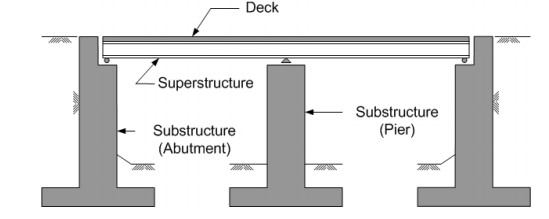
philosophy of modern reinforced concrete design is presented, and it is shown that it allows for the formation of cracks of controlled widths under service loads. Models for predicting the width of flexural cracks are reviewed. Factors Affecting drying shrinkage cracks and approximate methods for considering them are discussed. An Example is provided to illustrate how to determine whether drying shrinkage cracks will develop under specific conditions. This is followed by a discussion of techniques to predict the number and widths of drying shrinkage cracks. The abutment and piers of a bridge shows different crack patterns when it’s subjected to gravity loads and as well as moving loads, for that cracks in abutments and piers will be treats by using injectioning of Epoxy resins, retrofitting techniques etc.
Downloads
Published
Issue
Section
License
Copyright of articles published in the International Journal for Interdisciplinary Sciences and Engineering Applications (IJISEA) belongs to the Journal upon acceptance and publication, in accordance with the applicable author copyright agreement.
Authors may reuse their published work for educational and non-commercial purposes, provided that the original publication in IJISEA is properly acknowledged and the applicable permissions are obtained.
Any commercial reproduction, redistribution, republication, or other reuse beyond the permitted rights requires prior written permission from the Editorial Office.
The journal provides open access to its published articles for reading and scholarly reference. Access to published content does not automatically grant unrestricted reproduction or redistribution rights.
All rights not expressly granted remain reserved by the Journal.
 DOI Find a publication by DOI
