
High Speed Approximate 2n bit multiplier with n bit multipliers to reduce the design complexities
Keywords:
Multipliers, Matrix, hoc CircuitsAbstract
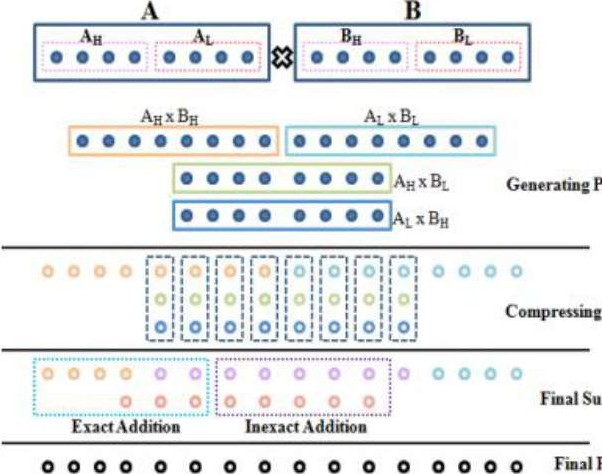
The structures Of matrix and tree-like multipliers Of binary numbers were reviewed and their system characteristics were show more affects on the digital signal processing applications. Approximate computing exploits the fact that many applications are inherently error resilient. In order to reduce power consumption approximate circuits such as multipliers have been employed in these applications. However, most current approximate multipliers are based on ad hoc circuit structures and, for automated circuit approximation methods, large efficient designs are difficult to find due to the increased search space. Here in this project we design a larger multiplier by using smaller multipliers such the approximation is done at the stage of partial product Addition. The internal structure Of incomplete one-bit adder adders has been proposed, Which allowed reducing the area Of multipliers and increases the speed Of operation. A comparative analysis Of the obtained results was made it possible for a designer to choose the optimal structure of the multiplier to accomplish the task of hardware multiplication of binary numbers with given system characteristics. The entire designs was synthesized and simulated in Xilinx ISE with verilog HDL coding.
Downloads
Published
Issue
Section
License
Copyright of articles published in the International Journal for Interdisciplinary Sciences and Engineering Applications (IJISEA) belongs to the Journal upon acceptance and publication, in accordance with the applicable author copyright agreement.
Authors may reuse their published work for educational and non-commercial purposes, provided that the original publication in IJISEA is properly acknowledged and the applicable permissions are obtained.
Any commercial reproduction, redistribution, republication, or other reuse beyond the permitted rights requires prior written permission from the Editorial Office.
The journal provides open access to its published articles for reading and scholarly reference. Access to published content does not automatically grant unrestricted reproduction or redistribution rights.
All rights not expressly granted remain reserved by the Journal.
 DOI Find a publication by DOI
