
Accumulator Based 3-Weight Pattern Generation for Complex Large Scale Integration Packages
Keywords:
Sequential Circuits, Combinational Circuits, PatterngenerationAbstract
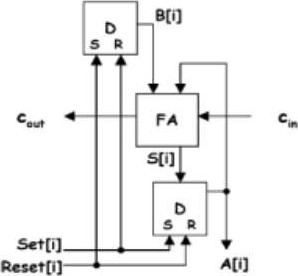
We describe a method for on-chip generation of weighted test sequences for synchronous sequential circuits. For combinational circuits, three weights, O, 0.5 and 1, are sufficient to achieve complete coverage of stuck-at faults, since these weights are sufficient to reproduce any specific test pattem. For sequential circuits, the weights we use are defined based on subsequences of a deterministic test sequence. Such weights allow us to parts of the test sequence, and help ensure that complete fault coverage would be obtained by the weighted test sequences generated. In this paper an accumulator-based 3-weight test pattern generation scheme is presented. The proposed scherne copes Wth the inherent drawbacks Of the scheme proposed more precisely. First, it does not impose any requirements about the design Of the adder i.e., it can be implemented using any adder design and then it does not require any modification of the adder; and hence it does not affect the operating speed of the adder. Furthermore, the proposed scheme compares favorably to the scheme proposed in terms of the required hardware overhead. The weighted random test pattem generation represents a significant departure from classical methods of generating test sequences for complex large scale integration packages. The virtue of this technique is its simplicity and the fact that test-generation time is virtually hdependent of or gates in the package to be tested. This technique can be used both in a conventional tester and in a tester where the weighted randorn test pattern generation IS implemented in hardware.
Downloads
Published
Issue
Section
License
Copyright of articles published in the International Journal for Interdisciplinary Sciences and Engineering Applications (IJISEA) belongs to the Journal upon acceptance and publication, in accordance with the applicable author copyright agreement.
Authors may reuse their published work for educational and non-commercial purposes, provided that the original publication in IJISEA is properly acknowledged and the applicable permissions are obtained.
Any commercial reproduction, redistribution, republication, or other reuse beyond the permitted rights requires prior written permission from the Editorial Office.
The journal provides open access to its published articles for reading and scholarly reference. Access to published content does not automatically grant unrestricted reproduction or redistribution rights.
All rights not expressly granted remain reserved by the Journal.
 DOI Find a publication by DOI
