
Classification of Cloud Services and Security Analysis in Healthcare Sector
Keywords:
Cloud Services, Risk Assessment, Healthcare SecurityAbstract
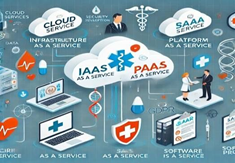
Cloud computing has become an essential technology in the healthcare industry, offering scalable, cost-effective, and flexible solutions for managing vast amounts of data, improving patient care, and enhancing operational efficiency. The three primary types of cloud services—Infrastructure as a Service (IaaS), Platform as a Service (PaaS), and Software as a Service (SaaS)—each play a unique role in healthcare organizations, supporting everything from data storage and management to software applications and platform development. Despite the many benefits, the adoption of cloud services in healthcare also introduces significant security and privacy challenges, particularly with regard to safeguarding sensitive patient information. This paper explores the classification of cloud services in the healthcare sector, examining how each model is applied to meet the diverse needs of healthcare providers. It also analyzes the security implications associated with cloud computing, focusing on critical issues such as data encryption, access controls, regulatory compliance (e.g., HIPAA and GDPR), and third-party risk management. A comprehensive understanding of these cloud service models and security concerns is essential for healthcare organizations to ensure the protection of patient data, meet legal and ethical standards, and fully leverage the advantages of cloud technologies. Ultimately, this study provides insights into how healthcare organizations can effectively balance the benefits of cloud computing with the need for robust data security measures to optimize patient care and organizational performance.
Downloads
Published
Issue
Section
License
Copyright of articles published in the International Journal for Interdisciplinary Sciences and Engineering Applications (IJISEA) belongs to the Journal upon acceptance and publication, in accordance with the applicable author copyright agreement.
Authors may reuse their published work for educational and non-commercial purposes, provided that the original publication in IJISEA is properly acknowledged and the applicable permissions are obtained.
Any commercial reproduction, redistribution, republication, or other reuse beyond the permitted rights requires prior written permission from the Editorial Office.
The journal provides open access to its published articles for reading and scholarly reference. Access to published content does not automatically grant unrestricted reproduction or redistribution rights.
All rights not expressly granted remain reserved by the Journal.
 DOI Find a publication by DOI
