
Face Emotion Detection System Using Deep Learning
Keywords:
Facial Emotion Recognition, Deep Learning, Convolutional Neural Network (CNN), YOLOv2, SqueezeNet, Real-Time Face Detection, Facial Expression Classification, Age Estimation, Gender Classification.Abstract
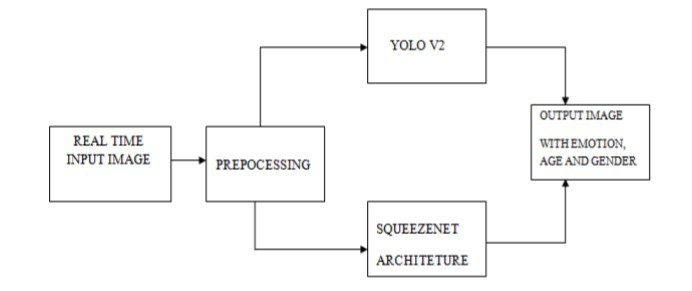
Now-a-days with the continued development of artificial intelligence facial emotion recognition has become more popular. The emotion recognition plays a major role in interaction technology. In interaction technology the verbal components only play a one third of communication and the non-verbal components plays a two third of communication. A facial emotion recognition (FER) method is used for detecting facial expressions. Facial expression plays a major role in expressing what a person feels and it expresses inner feeling and his or her mental situation or human perspective. This paper aims to identify basic human emotions with the combination of gender classification and age estimation. The facial emotions such as happy, sad, angry, fear, surprised, neutral emotions are considered as basic emotions. Here proposes a real time facial emotion recognition system based on You Look Only Once (YOLO) version 2 architecture and a squeeze net architecture. The yolo architecture is a real time object detection system. Here it used for identify and detect faces in real time. These images are captured by using anchor boxes for accuracy. The second architecture is squeezing net and is used for gender classification and age estimation. It provides significant, accurate object detection and extracts high-level features that help to achieve tremendous performance to classify the image and detecting objects. Both the architectures provide accurate result than other methods with the large no of hidden layers and cross validation in the neural network.
Downloads
Published
Issue
Section
License
Copyright of articles published in the International Journal for Interdisciplinary Sciences and Engineering Applications (IJISEA) belongs to the Journal upon acceptance and publication, in accordance with the applicable author copyright agreement.
Authors may reuse their published work for educational and non-commercial purposes, provided that the original publication in IJISEA is properly acknowledged and the applicable permissions are obtained.
Any commercial reproduction, redistribution, republication, or other reuse beyond the permitted rights requires prior written permission from the Editorial Office.
The journal provides open access to its published articles for reading and scholarly reference. Access to published content does not automatically grant unrestricted reproduction or redistribution rights.
All rights not expressly granted remain reserved by the Journal.
 DOI Find a publication by DOI
