
AI-Driven Multilingual Translation System for Indian Languages
Keywords:
Multilingual, Translation System, Indian Languages, Artificial Intelligence (AI), Natural Language Processing (NLP), Indigenous Languages, Neural Machine Translation (NMT), Attention Mechanism, Deep Learning, Contextual Understanding, BERT (Bidirectional Encoder Representations from Transformers)Abstract
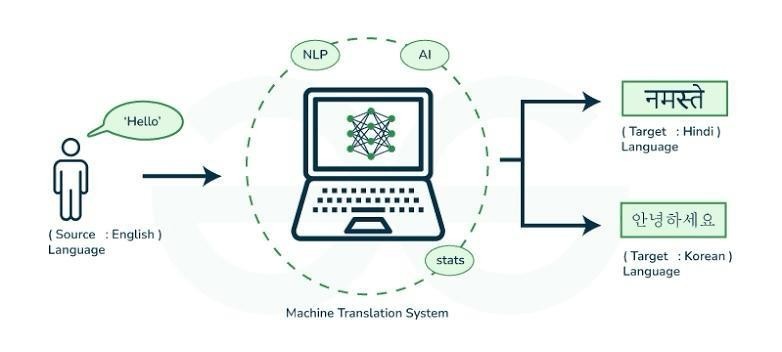
India is celebrated for its rich shade of languages, with over 22 sanctioned languages and a multitude of cants shaping its different cultural heritage. still, this verbal wealth also poses challenges in digital communication, where language walls can hinder the free flux of information. The AI- Driven Multilingual paraphrase System for Indian Languages aims to bridge these gaps by employing modern Artificial Intelligence (AI) and Natural Language Processing (NLP) ways to grease indefectible paraphrase across different verbal communities. The primary thing of the design is to develop a robust paraphrase system that focuses on indigenous languages constantly underrepresented in traditional paraphrase tools. using advanced deep knowledge models — particularly Neural Machine paraphrase (NMT) enhanced by attention mechanisms the system captures nuanced contextual details to give paraphrases that are both accurate and natural. By integrating motor- predicated architectures like BERT and GPT, it moves beyond conventional rule- predicated and statistical styles, employing the power of extensive multilingual datasets. Scalability is a crucial design principle, icing the system can expand to accommodate fresh languages and cants over time. An intuitive stoner interface further promotes availability for druggies of all specialized backgrounds. This comprehensive approach not only eases everyday communication but also holds significant pledge for sectors similar as government, education, media, ande- commerce. This innovative system not only redefines digital restatement within India but also dramatically paves the way for setting truly transformative global norms.
Downloads
Published
Issue
Section
License
Copyright of articles published in the International Journal for Interdisciplinary Sciences and Engineering Applications (IJISEA) belongs to the Journal upon acceptance and publication, in accordance with the applicable author copyright agreement.
Authors may reuse their published work for educational and non-commercial purposes, provided that the original publication in IJISEA is properly acknowledged and the applicable permissions are obtained.
Any commercial reproduction, redistribution, republication, or other reuse beyond the permitted rights requires prior written permission from the Editorial Office.
The journal provides open access to its published articles for reading and scholarly reference. Access to published content does not automatically grant unrestricted reproduction or redistribution rights.
All rights not expressly granted remain reserved by the Journal.
 DOI Find a publication by DOI
