
Underground Cable Fault Detection Using IoT
Keywords:
Arduino, ADC, ESP8266, LCD display, fault detection, Internet of Things (IoT), underground cable, short-circuit fault, cloud monitoring, power distribution.Abstract
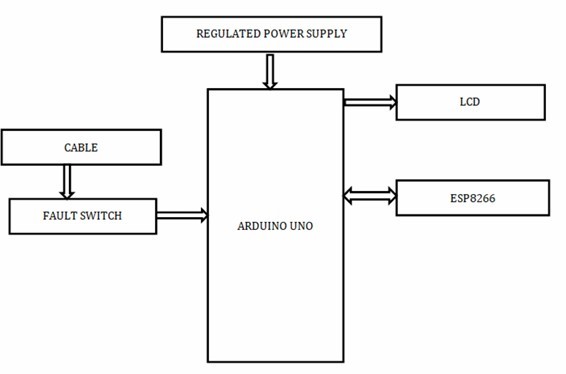
To precisely detect and locate short-circuit faults in metropolitan power distribution networks, this research proposes an Internet of Things (IoT)-based underground cable fault detection system. Modern cities use a large number of underground cables; therefore, accurate and timely fault detection is essential for maintaining a reliable power supply and efficient maintenance. The proposed system monitors voltage fluctuations caused by faults using an Arduino microcontroller and current-sensing circuitry. The microcontroller’s built-in Analog-to-Digital Converter (ADC) converts these signals into digital values, enabling the calculation of the fault distance from the base station in kilometers. Switches are used to simulate fault conditions, while relay circuits control system operations. The type and location of the fault are displayed in real time on a 16×2 Liquid Crystal Display (LCD). In addition, fault data is transmitted to a cloud platform through an ESP8266 Wi-Fi module for remote monitoring and analysis. A buzzer is also included to immediately alert field personnel when a fault occurs. This system provides a reliable, efficient, and cost-effective solution for detecting underground cable faults, reducing repair time, and improving service continuity.
Downloads
Published
Issue
Section
License
Copyright of articles published in the International Journal for Interdisciplinary Sciences and Engineering Applications (IJISEA) belongs to the Journal upon acceptance and publication, in accordance with the applicable author copyright agreement.
Authors may reuse their published work for educational and non-commercial purposes, provided that the original publication in IJISEA is properly acknowledged and the applicable permissions are obtained.
Any commercial reproduction, redistribution, republication, or other reuse beyond the permitted rights requires prior written permission from the Editorial Office.
The journal provides open access to its published articles for reading and scholarly reference. Access to published content does not automatically grant unrestricted reproduction or redistribution rights.
All rights not expressly granted remain reserved by the Journal.
 DOI Find a publication by DOI
