
Design and Implementation of RSA Cryptography Using an Inexact Multiplier
Keywords:
Cryptography, Dadda Multiplier, Speed, Power ConsumptionAbstract
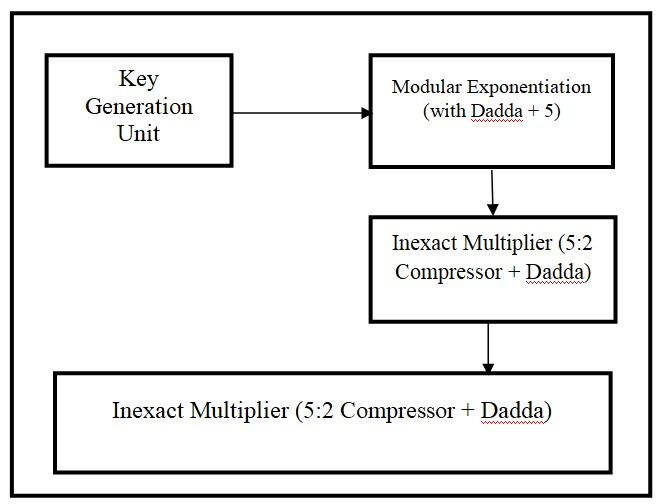
Cryptography used in encryption and decryption for the purpose of security in communication. Rivest Shamir Adleman or RSA is an algorithm which is used to send data. In this, mainly focuses on encryption techniques like cryptography which have large integer multiplications like modular exponentiation. However, these operations required large hardware architecture. This makes traditional RSA implementations inefficient for low power and resource constrained applications like Internet of things (IOT) devices, embedded systems and real time multimedia encryption. To overcome these limitations, this project introduces an optimized RSA cryptographic architecture that contains 8-bit Dadda multiplier and 5:2 compressor which will balance the performance. The 5:2 compressor reduces the number of addition stages in the product multiplication, while the Dadda multiplier focuses on fast multiplication. This inexact multiplier design significantly reduces the power consumption, Low area requirement, Improved Scalability and Faster computation which is well suited for energy aware hardware environments. The proposed design achieves 27% power reduction while preserving encryption accuracy. Although there is a slight decryption error that is negligible. The encryption simulation shows that the result is unaffected. The traditional RSA design uses Exact multipliers like carry save and array-based designs which consume more power and the logic structure is complex. In contrast, the approximate computing approach sacrifices a minimal amount of accuracy in Favor of Dadda-based multipliers, offers several distinct advantages over traditional RSA hardware implementations.
Downloads
Published
Issue
Section
License
Copyright of articles published in the International Journal for Interdisciplinary Sciences and Engineering Applications (IJISEA) belongs to the Journal upon acceptance and publication, in accordance with the applicable author copyright agreement.
Authors may reuse their published work for educational and non-commercial purposes, provided that the original publication in IJISEA is properly acknowledged and the applicable permissions are obtained.
Any commercial reproduction, redistribution, republication, or other reuse beyond the permitted rights requires prior written permission from the Editorial Office.
The journal provides open access to its published articles for reading and scholarly reference. Access to published content does not automatically grant unrestricted reproduction or redistribution rights.
All rights not expressly granted remain reserved by the Journal.
 DOI Find a publication by DOI
