
Predicting Crop Prices with Machine Learning Techniques
Keywords:
Crop Price Prediction, Machine Learning, Decision Tree Regression, Agricultural Forecasting, Random Forest, K-Nearest Neighbors (KNN), Crop Yield Prediction, Weather Forecasting, Precision Agriculture, Fertilizer Recommendation.Abstract
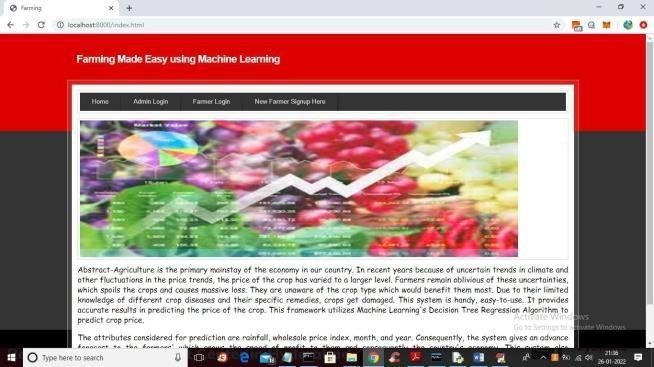
Agriculture forms the backbone of our nation’s economy. However, in recent years, unpredictable climatic conditions and fluctuations in market trends have caused significant variability in crop prices. These uncertainties often catch farmers off guard, leading to crop spoilage and substantial financial losses. Moreover, limited awareness of profitable crop choices and insufficient knowledge about crop-specific diseases and remedies further worsen the situation. To address these challenges, we propose an intuitive and user-friendly system that accurately predicts crop prices using Machine Learning techniques. Specifically, the model employs a Decision Tree Regression algorithm and considers features such as rainfall, wholesale price index, month, and year for effective forecasting. By providing advance pricing predictions, the system empowers farmers to make informed decisions, thereby boosting their profitability and contributing positively to the national economy. In addition, the platform includes supplementary modules such as weather forecasting, crop and fertilizer recommendations, and integrated features like a shopping portal, chat support, and multilingual guides — making it a comprehensive agricultural assistant.
Downloads
Published
Issue
Section
License
Copyright of articles published in the International Journal for Interdisciplinary Sciences and Engineering Applications (IJISEA) belongs to the Journal upon acceptance and publication, in accordance with the applicable author copyright agreement.
Authors may reuse their published work for educational and non-commercial purposes, provided that the original publication in IJISEA is properly acknowledged and the applicable permissions are obtained.
Any commercial reproduction, redistribution, republication, or other reuse beyond the permitted rights requires prior written permission from the Editorial Office.
The journal provides open access to its published articles for reading and scholarly reference. Access to published content does not automatically grant unrestricted reproduction or redistribution rights.
All rights not expressly granted remain reserved by the Journal.
 DOI Find a publication by DOI
