
RACH procedure in 4G technology
Keywords:
RACH, LTE, Random Access Procedure, eNodeB, Contention-Based Access, Uplink Synchronization, Wireless CommunicationAbstract
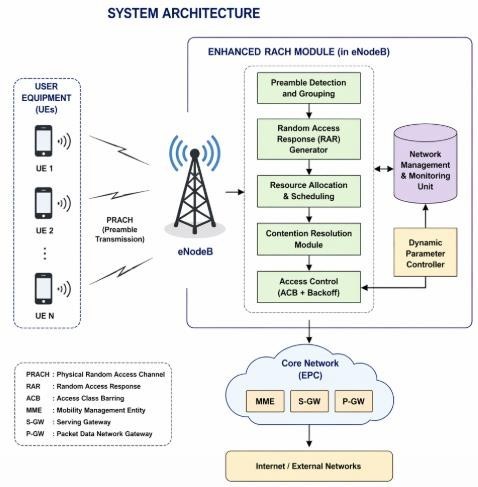
The Random-Access Channel (RACH) procedure in Fourth Generation (4G) Long Term Evolution (LTE) technology plays a critical role in establishing initial communication between User Equipment (UE) and the evolved NodeB (eNodeB). This paper presents an overview of the RACH procedure, highlighting its significance in uplink synchronization, connection establishment, and mobility management. The RACH process is primarily categorized into contention-based and contention-free access mechanisms, each designed to handle different network scenarios such as initial access, handover, and uplink data transmission. The procedure involves a four-step handshake, including preamble transmission, random access response, scheduled transmission, and contention resolution. Efficient handling of RACH is essential to minimize access delay, avoid collisions, and enhance overall network performance, especially in high-density environments. Challenges such as preamble collision, latency, and resource allocation are discussed, along with potential optimization techniques like dynamic resource allocation and backoff algorithms. The study emphasizes the importance of RACH in ensuring reliable and scalable communication in LTE networks. Overall, understanding and improving the RACH procedure is vital for maintaining Quality of Service (QoS) and supporting the increasing demand for mobile data services in modern wireless communication systems.
Downloads
Published
Issue
Section
License
Copyright of articles published in the International Journal for Interdisciplinary Sciences and Engineering Applications (IJISEA) belongs to the Journal upon acceptance and publication, in accordance with the applicable author copyright agreement.
Authors may reuse their published work for educational and non-commercial purposes, provided that the original publication in IJISEA is properly acknowledged and the applicable permissions are obtained.
Any commercial reproduction, redistribution, republication, or other reuse beyond the permitted rights requires prior written permission from the Editorial Office.
The journal provides open access to its published articles for reading and scholarly reference. Access to published content does not automatically grant unrestricted reproduction or redistribution rights.
All rights not expressly granted remain reserved by the Journal.
 DOI Find a publication by DOI
