
Smart Crime Analytics and High-Risk Zone Fore Casting System Using Historical Case Records and Geo Visualization
Keywords:
Interactive Data Upload & Filtering, Data Preprocessing & Cleaning, Geospatial Crime Visualization, High-Risk Zone Identification, Temporal Trend Analysis, Predictive Analytics Integration, Real-Time Dashboard Monitoring.Abstract
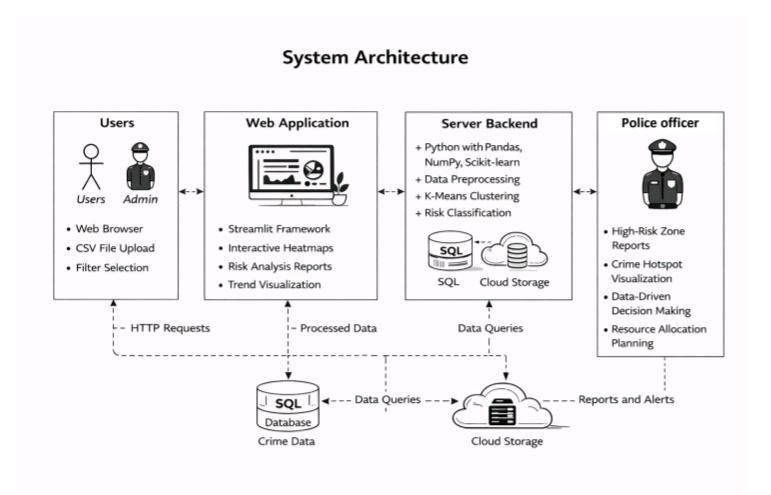
The Smart Crime Analytics and High-Risk Zone Forecasting System is an intelligent data analytics platform developed using Streamlit, Pandas, and Folium to analyze historical crime datasets and forecast high-risk areas through geo-visualization and temporal trend analysis. The system enables users to upload crime records, apply city and crime-type filters, and visualize spatial crime patterns via interactive heatmaps and marker clusters. It computes risk levels by aggregating incident frequencies or clusters and presents monthly crime trends for predictive insights. By integrating data preprocessing, geospatial mapping, and predictive analytics, the platform aids law enforcement agencies in strategic decision-making, crime prevention, and resource optimization. In addition, the system incorporates automated data cleaning and validation mechanisms to handle missing values, inconsistent entries, and duplicate records, ensuring high data quality and reliability of analysis. It also supports real-time dashboard updates and dynamic visual analytics, allowing stakeholders to monitor evolving crime patterns and rapidly respond to emerging threats. Furthermore, the platform is designed with scalability and modular architecture, enabling integration with external data sources such as demographic statistics, weather data, and surveillance inputs to enhance predictive accuracy and long-term strategic planning.
Downloads
Published
Issue
Section
License
Copyright of articles published in the International Journal for Interdisciplinary Sciences and Engineering Applications (IJISEA) belongs to the Journal upon acceptance and publication, in accordance with the applicable author copyright agreement.
Authors may reuse their published work for educational and non-commercial purposes, provided that the original publication in IJISEA is properly acknowledged and the applicable permissions are obtained.
Any commercial reproduction, redistribution, republication, or other reuse beyond the permitted rights requires prior written permission from the Editorial Office.
The journal provides open access to its published articles for reading and scholarly reference. Access to published content does not automatically grant unrestricted reproduction or redistribution rights.
All rights not expressly granted remain reserved by the Journal.
 DOI Find a publication by DOI
