
Advanced Demand Forecasting for Retail Supply Chain Management Using Data Science and Machine Learning Inventory Optimization
Keywords:
Demand Forecasting, Retail Inventory Optimization, Machine Learning (XGBoost), Streamlit Web App, Data Visualization, Predictive Analytics, Root Mean Square Error (RMSE), Real- Time Prediction, Inventory ManagementAbstract
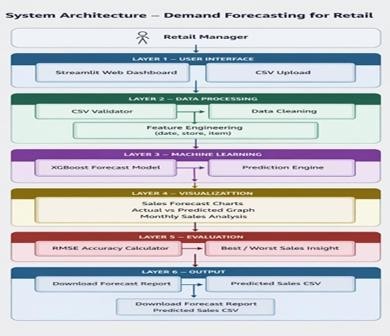
This project presents an interactive Streamlit-based web application that enables advanced demand forecasting for retail supply chain management using a pre trained XGBoost machine learning model. The main goal is to optimize inventory by accurately predicting daily item-level sales based on features like store ID, item ID, and date attributes (year, month, day, day of week). Users can upload a CSV file containing test data, and the application performs real-time sales predictions using the trained model. The app provides rich visual analytics including monthly sales trends, store and item-specific breakdowns, and actual vs. predicted comparison charts. It also highlights the month with the highest sales and calculates metrics such as Root Mean Square Error (RMSE) when actual sales data is available. Users can download the forecast results as a CSV file for further analysis. The application uses data preprocessing, Seaborn and Matplotlib for plotting, and joblib for loading the XGBoost model efficiently. Through an intuitive interface, it empowers retailers to make data-driven inventory decisions, reduce overstock or understock issues, and enhance operational efficiency
Downloads
Published
Issue
Section
License
Copyright of articles published in the International Journal for Interdisciplinary Sciences and Engineering Applications (IJISEA) belongs to the Journal upon acceptance and publication, in accordance with the applicable author copyright agreement.
Authors may reuse their published work for educational and non-commercial purposes, provided that the original publication in IJISEA is properly acknowledged and the applicable permissions are obtained.
Any commercial reproduction, redistribution, republication, or other reuse beyond the permitted rights requires prior written permission from the Editorial Office.
The journal provides open access to its published articles for reading and scholarly reference. Access to published content does not automatically grant unrestricted reproduction or redistribution rights.
All rights not expressly granted remain reserved by the Journal.
 DOI Find a publication by DOI
