
AI Based Brain Stroke Prediction Using MRI Images and Vision Transformer Models
Keywords:
Brain Stroke Prediction, Vision Transformer (ViT), MRI Classification, Deep Learning, CNN, ResNet, PyTorch, Streamlit, Medical Image Analysis, Transfer Learning.Abstract
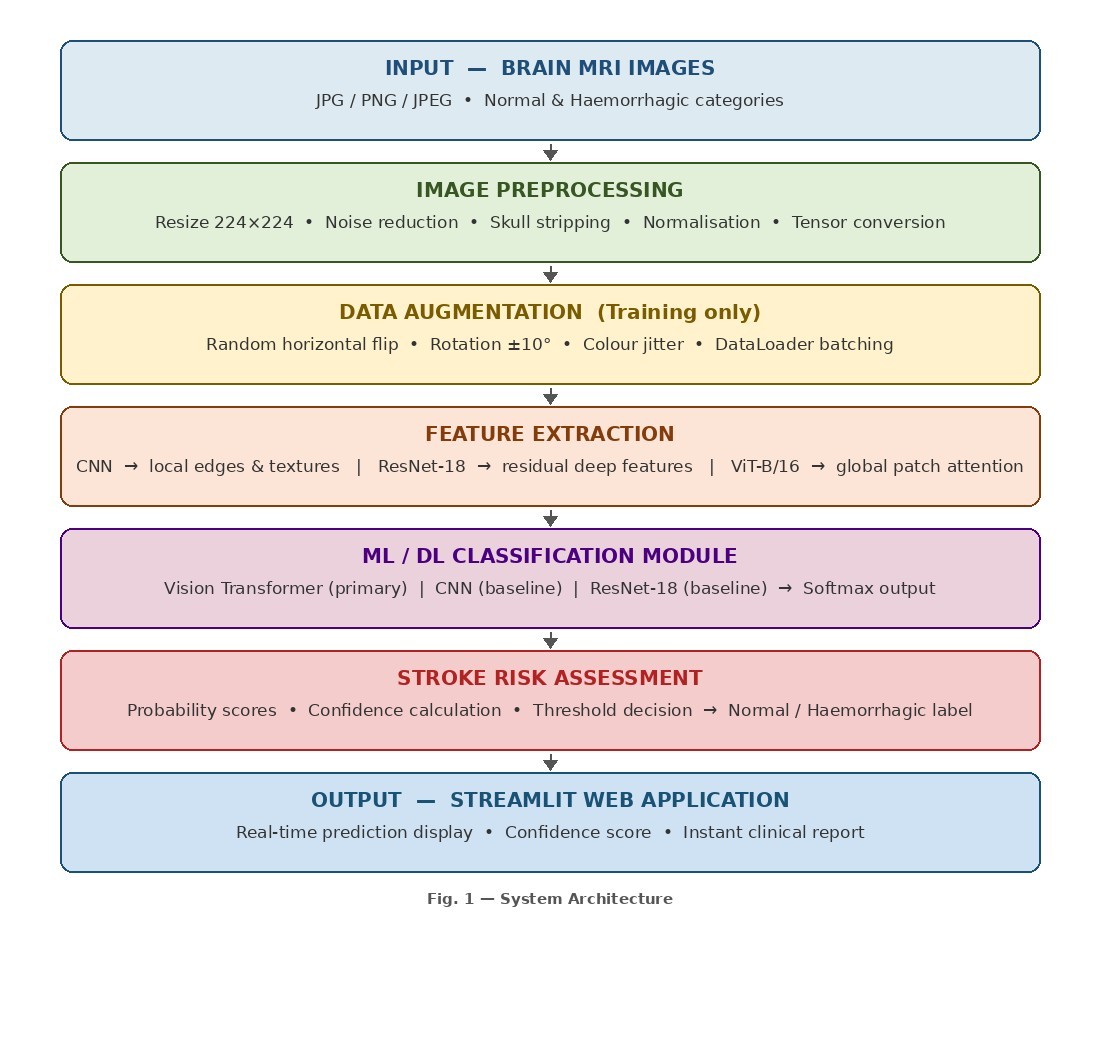
Stroke is a severe neurological condition that requires early and accurate diagnosis to improve patient outcomes. This paper presents an AI-based brain stroke classification system using Vision Transformers (ViT-B/16) to classify brain MRI scans into Normal and Haemorrhagic categories. The dataset is preprocessed and augmented using techniques including random horizontal flip, rotation, and colour jitter to enhance model generalisation. We compare three architectures — Convolutional Neural Networks (CNN), ResNet-18, and Vision Transformer (ViT) — finding that ViT significantly outperforms both baselines. The ViT-B/16 model achieves 97.59% accuracy, surpassing VGG-16 (90%), ResNet-50 (87%), InceptionV3 (82%), and VGG-19 (81%), with precision, recall, and F1-scores all exceeding 0.96. The system leverages PyTorch's torchvision library with pre-trained ViT-B/16 weights fine-tuned on the stroke MRI dataset. A Streamlit-based web application enables clinical staff to upload MRI images and receive real-time stroke classification predictions without programming knowledge, demonstrating the viability of Vision Transformers for automated medical image analysis and clinical decision support.
Downloads
Published
Issue
Section
License
Copyright of articles published in the International Journal for Interdisciplinary Sciences and Engineering Applications (IJISEA) belongs to the Journal upon acceptance and publication, in accordance with the applicable author copyright agreement.
Authors may reuse their published work for educational and non-commercial purposes, provided that the original publication in IJISEA is properly acknowledged and the applicable permissions are obtained.
Any commercial reproduction, redistribution, republication, or other reuse beyond the permitted rights requires prior written permission from the Editorial Office.
The journal provides open access to its published articles for reading and scholarly reference. Access to published content does not automatically grant unrestricted reproduction or redistribution rights.
All rights not expressly granted remain reserved by the Journal.
 DOI Find a publication by DOI
