
A Data Driven Approach to Ransomware Detection with Machine Learning
Keywords:
Ransomware Detection, Machine Learning, Random Forest, PE Header Analysis, Feature Extraction, LIME Explainability, SMOTE-TOMEK, Cybersecurity, Malware ClassificationAbstract
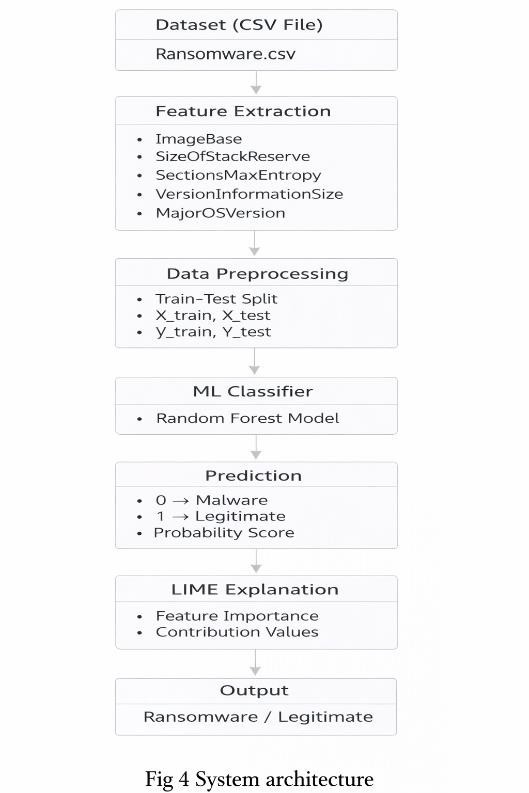
Ransomware attacks represent a growing cybersecurity threat, affecting individuals and organizations by compromising data integrity, causing financial losses, and damaging reputations [1]. Early and accurate detection of ransomware is essential to mitigate these risks. This study presents a data-driven machine learning approach for ransomware detection using a dataset of 138,047 executable file records. The proposed system extracts critical Portable Executable (PE) header features — including Image Base, Sections Max Entropy, and Version In formation Size — and applies a Random Forest classifier to distinguish between legitimate and malicious files [4]. To address class imbalance, SMOTE-TOMEK resampling is applied before model training. The LIME (Local Interpretable Model-agnostic Explanations) framework is integrated to provide transparency in model predictions. The system achieves an accuracy of 99.38%, precision of 98.83%, recall of 99.13%, F1-score of 98.98%, and an AUC of 99.95%, demonstrating highly reliable ransomware identification with minimal false positives [6].
Downloads
Published
Issue
Section
License
Copyright of articles published in the International Journal for Interdisciplinary Sciences and Engineering Applications (IJISEA) belongs to the Journal upon acceptance and publication, in accordance with the applicable author copyright agreement.
Authors may reuse their published work for educational and non-commercial purposes, provided that the original publication in IJISEA is properly acknowledged and the applicable permissions are obtained.
Any commercial reproduction, redistribution, republication, or other reuse beyond the permitted rights requires prior written permission from the Editorial Office.
The journal provides open access to its published articles for reading and scholarly reference. Access to published content does not automatically grant unrestricted reproduction or redistribution rights.
All rights not expressly granted remain reserved by the Journal.
 DOI Find a publication by DOI
