
Ai-Powered Book Recommendation Framework Using Natural Language Processing
Keywords:
Book Recommendation System, Natural Language Processing (NLP), TF-IDF, Cosine Similarity, Content-Based Filtering, Semantic Analysis, Topic Modeling, Streamlit, Recommender Systems, MLOps.Abstract
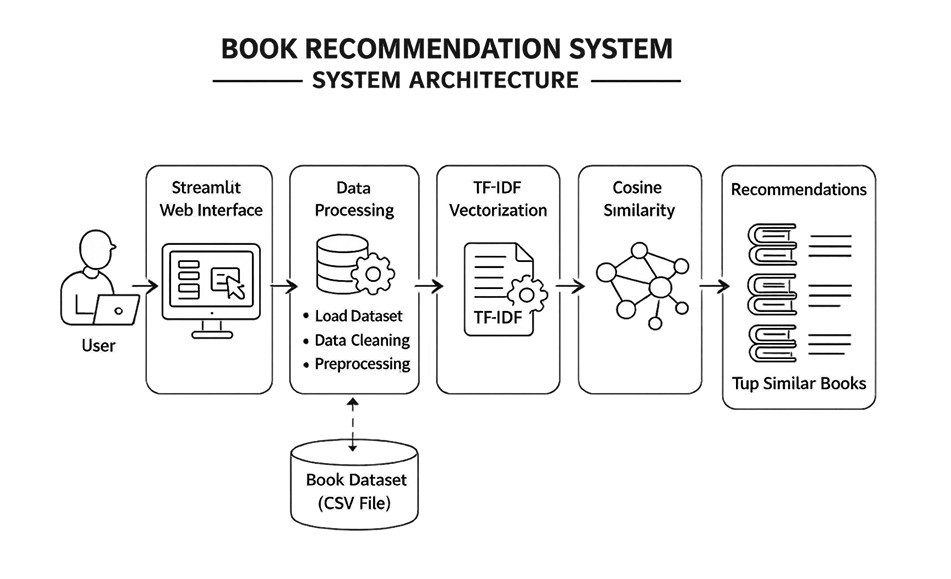
The exponential growth of digital reading platforms has resulted in the availability of millions of books online, posing a significant challenge for users in identifying content aligned with their interests. Conventional recommendation systems, primarily based on collaborative filtering and user ratings, often encounter critical limitations such as the cold-start problem and data sparsity, which adversely affect their performance and scalability. To address these challenges, this paper presents an AI-powered content-based book recommendation framework that leverages Natural Language Processing (NLP) techniques to generate accurate and meaningful recommendations using only textual descriptions of books. The proposed system employs Term Frequency–Inverse Document Frequency (TF-IDF) for feature extraction and Cosine Similarity for measuring semantic relationships between book descriptions. The framework incorporates comprehensive Exploratory Data Analysis (EDA) and robust text preprocessing techniques, including tokenization, stop-word removal, and normalization, to enhance data quality and representation. The processed textual data is transformed into high-dimensional vector space representations, enabling efficient similarity computation and retrieval of relevant books.Furthermore, the system integrates semantic topic modeling to improve diversity and mitigate over-specialization in recommendations. An interactive Streamlit-based web application is developed to provide real-time user interaction and recommendation visualization. The proposed approach demonstrates high relevance and accuracy in recommendations while effectively overcoming the limitations of traditional systems. Additionally, it presents a lightweight end-to-end MLOps pipeline, encompassing data processing, model development, and deployment for scalable NLP-driven recommendation systems.
Downloads
Published
Issue
Section
License
Copyright of articles published in the International Journal for Interdisciplinary Sciences and Engineering Applications (IJISEA) belongs to the Journal upon acceptance and publication, in accordance with the applicable author copyright agreement.
Authors may reuse their published work for educational and non-commercial purposes, provided that the original publication in IJISEA is properly acknowledged and the applicable permissions are obtained.
Any commercial reproduction, redistribution, republication, or other reuse beyond the permitted rights requires prior written permission from the Editorial Office.
The journal provides open access to its published articles for reading and scholarly reference. Access to published content does not automatically grant unrestricted reproduction or redistribution rights.
All rights not expressly granted remain reserved by the Journal.
 DOI Find a publication by DOI
