
Customer Churn Prediction and Retention Strategy Optimization for Subscription-Based Services Using Behavioural Data Analytics and Machine Learning Models
Keywords:
Customer Churn Prediction, Retention Strategy, Machine Learning, Streamlit Dashboard,, Classification Models, Logistic Regression, Decision Tree, Random Forest, Support Vector Machine, Gradient Boosting, XGBoost, LightGBM, CatBoost, Data Preprocessing, Feature Importance, Churn Probability, Predictive Analytics, Customer Retention, Data Visualization.Abstract
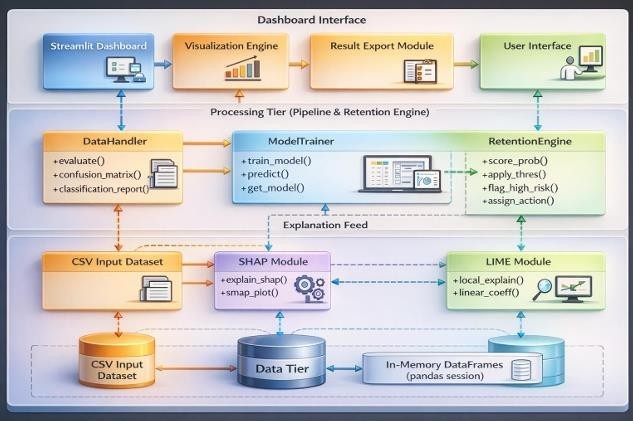
This project presents a user-friendly Customer Churn Prediction and Retention Dashboard developed using Streamlit. The tool enables business users and analysts to upload customer datasets in CSV format, preprocess the data, and apply multiple machine learning models to predict customer churn. Supported models include Logistic Regression, Decision Tree, Random Forest, Support Vector Machine, Gradient Boosting, XGBoost, LightGBM, and CatBoost. The dataset is automatically encoded and scaled for compatibility with the models. Once trained, the selected model predicts customer churn and evaluates performance using metrics such as accuracy score, classification report, and confusion matrix. The dashboard also computes churn probabilities and recommends retention actions for high-risk customers (e.g., offering incentives to those with a churn probability > 0.7). It includes visualizations such as churn distribution, retention action breakdown, and feature importance for better interpretability. This approach not only aids in understanding customer behavior but also supports proactive decision-making to improve retention. Users can download the enriched dataset with churn probabilities and retention strategies for further business use.
Downloads
Published
Issue
Section
License
Copyright of articles published in the International Journal for Interdisciplinary Sciences and Engineering Applications (IJISEA) belongs to the Journal upon acceptance and publication, in accordance with the applicable author copyright agreement.
Authors may reuse their published work for educational and non-commercial purposes, provided that the original publication in IJISEA is properly acknowledged and the applicable permissions are obtained.
Any commercial reproduction, redistribution, republication, or other reuse beyond the permitted rights requires prior written permission from the Editorial Office.
The journal provides open access to its published articles for reading and scholarly reference. Access to published content does not automatically grant unrestricted reproduction or redistribution rights.
All rights not expressly granted remain reserved by the Journal.
 DOI Find a publication by DOI
