
Personalized Itinerary Planning & Dynamic Pricing
Keywords:
Streamlit, Lang Chain, Large Language Model (LLM), Groq, AI, Travel Planner, Itinerary, Markdown, Python, Generative AI, Prompt Engineering.Abstract
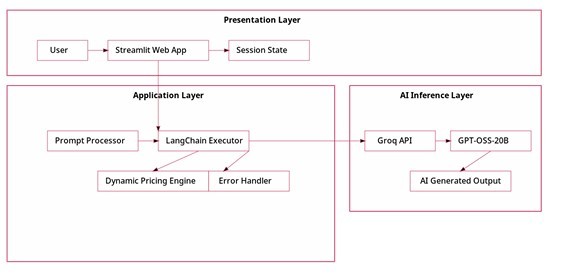
This project presents a web-based AI-powered travel itinerary planner, built as a Streamlit application. It demonstrates an end-to-end implementation of a generative AI workflow, primarily utilizing the Lang Chain orchestration framework and a Large Language Model (LLM) accessed through the Groq API. The application's architecture is structured to facilitate a clear user interaction flow. The Streamlit front-end provides an intuitive graphical user interface (GUI) where users can input travel parameters such as destination, trip duration, interests, and preferred travel style. This user input is then used to dynamically populate a Chat Prompt Template from the Lang Chain library. This template acts as a crucial interface, translating the user's high-level requirements into a structured, explicit prompt for the LLM. The project is designed with a focus on security and best practices, employing environment variables for managing API keys. This approach ensures that sensitive credentials are not hard-coded, making the application more secure and easily deployable across different environments. The integration of custom CSS further enhances the user experience by providing a modern, clean aesthetic. This project serves as a practical example of building a fullstack, AI-driven application, highlighting the power of combining modern web frameworks with advanced LLMs.
Downloads
Published
Issue
Section
License
Copyright of articles published in the International Journal for Interdisciplinary Sciences and Engineering Applications (IJISEA) belongs to the Journal upon acceptance and publication, in accordance with the applicable author copyright agreement.
Authors may reuse their published work for educational and non-commercial purposes, provided that the original publication in IJISEA is properly acknowledged and the applicable permissions are obtained.
Any commercial reproduction, redistribution, republication, or other reuse beyond the permitted rights requires prior written permission from the Editorial Office.
The journal provides open access to its published articles for reading and scholarly reference. Access to published content does not automatically grant unrestricted reproduction or redistribution rights.
All rights not expressly granted remain reserved by the Journal.
 DOI Find a publication by DOI
