
An Ai-Powered Predictive Health Nexus for Proactive Disease Identification and Personalized Patient Outcome Forecasting
Keywords:
Heart Disease Prediction, Machine Learning, Logistic Regression, Fast API, Healthcare Analytics, Real-Time Prediction, Data Visualization, Web Application, Predictive Modelling, Preventive HealthcareAbstract
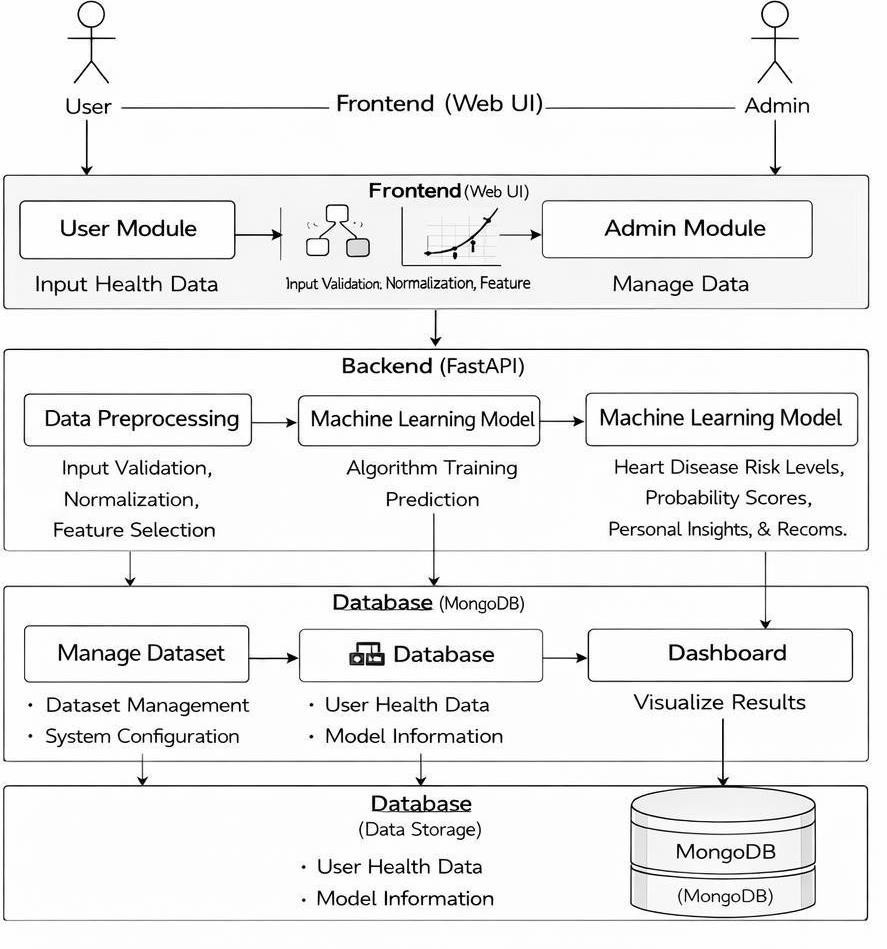
Heart disease is a leading cause of mortality worldwide, making early detection essential. This project presents a Smart Heart Disease Prediction System, an AI-powered web application that predicts the likelihood of heart disease using machine learning based on clinical parameters such as age, sex, chest pain type, blood pressure, cholesterol, fasting blood sugar, ECG results, maximum heart rate, exerciseinduced angina, old peak, and ST slope. The system uses a trained classification model deployed through a Fast API backend for real-time prediction, with a user-friendly frontend built using HTML, CSS, and JavaScript. It classifies patients into high or low risk, provides probability scores, personalized health insights, and recommended actions for preventive care. An interactive dashboard visualizes key data patterns like age, gender, and disease distribution, enhancing understanding. By integrating machine learning, web technologies, and data visualization, the system offers a scalable and efficient solution for early screening, telemedicine support, and improved healthcare decision making.
Downloads
Published
Issue
Section
License
Copyright of articles published in the International Journal for Interdisciplinary Sciences and Engineering Applications (IJISEA) belongs to the Journal upon acceptance and publication, in accordance with the applicable author copyright agreement.
Authors may reuse their published work for educational and non-commercial purposes, provided that the original publication in IJISEA is properly acknowledged and the applicable permissions are obtained.
Any commercial reproduction, redistribution, republication, or other reuse beyond the permitted rights requires prior written permission from the Editorial Office.
The journal provides open access to its published articles for reading and scholarly reference. Access to published content does not automatically grant unrestricted reproduction or redistribution rights.
All rights not expressly granted remain reserved by the Journal.
 DOI Find a publication by DOI
