
Identification of Psychological Stress from Speech Signal Using Deep Learning Algorithm
Keywords:
Psychological Stress Detection, BERT, Deep Learning, NLP, Speech Signal Analysis, MFCCs, Text Classification, Mental Health Monitoring, Transformer Models, Streamlit, PyTorch, Real-Time DetectionAbstract
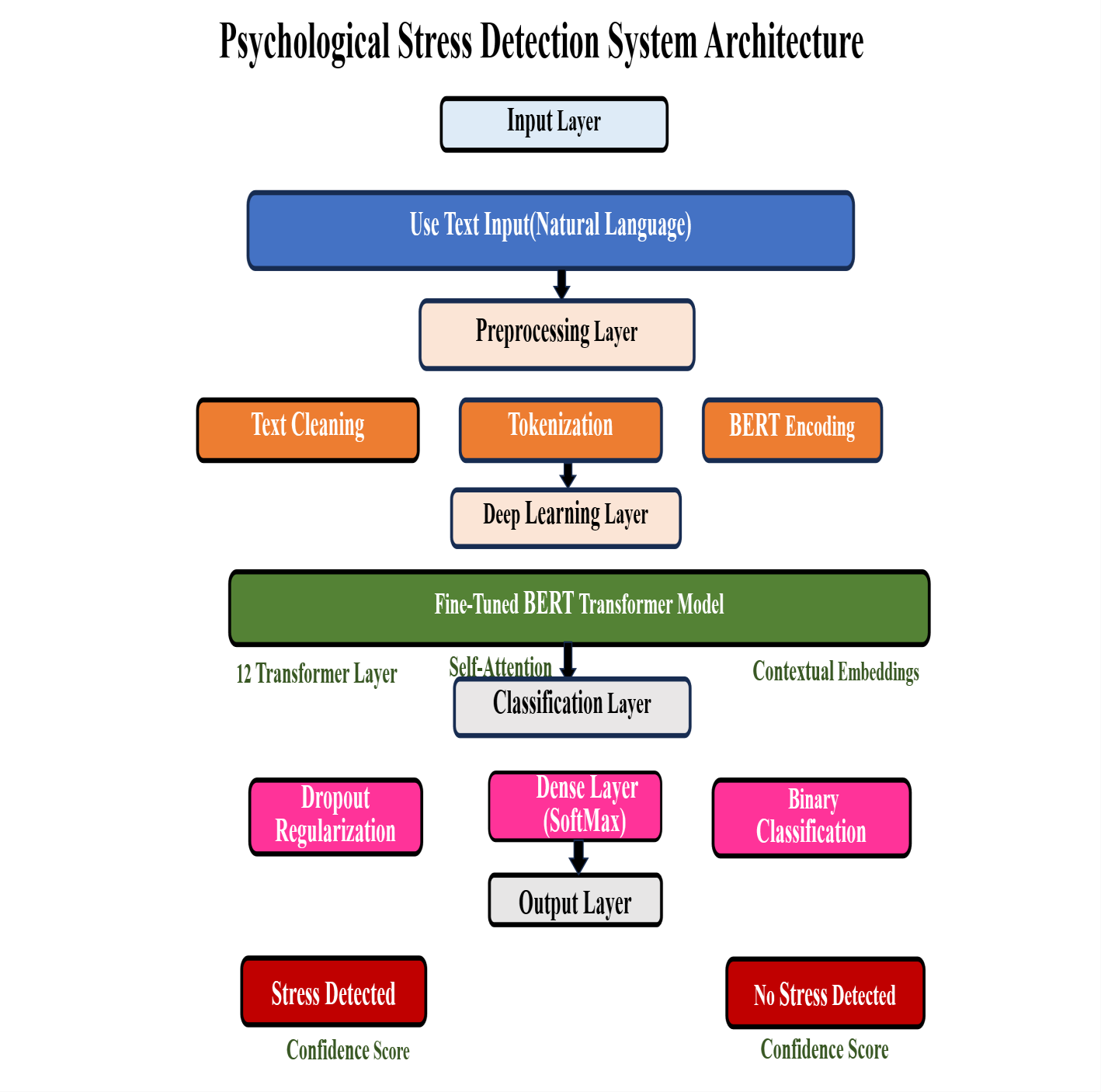
Psychological stress has become a major issue in modern society due to increasing academic, social, and professional pressures, and early detection is critical to prevent serious mental health consequences. Existing systems predominantly rely on traditional assessment approaches such as surveys, questionnaires, and expert psychological evaluations, which are time-consuming, inherently subjective, and require trained clinical professionals. To overcome these limitations, this paper proposes an automated stress detection system built upon BERT (Bidirectional Encoder Representations from Transformers), a state-of-the-art deep learning model that analyzes user generated text to classify whether content indicates stress or non-stress conditions. The system processes text through preprocessing, tokenization, and fine-tuned model training using Natural Language Processing (NLP) techniques. The technology stack includes Python, BERT, Deep Learning, NLP, PyTorch, the Transformers library, and Streamlit for a user-friendly web interface enabling realtime text analysis and probability visualization. Through optimized training strategies including stratified data splitting, learning rate scheduling, dropout regularization, and balanced datasets, the system achieves an accuracy exceeding 95%, making it a reliable and scalable tool for early psychological stress detection in educational, workplace, and healthcare environments.
Downloads
Published
Issue
Section
License
Copyright of articles published in the International Journal for Interdisciplinary Sciences and Engineering Applications (IJISEA) belongs to the Journal upon acceptance and publication, in accordance with the applicable author copyright agreement.
Authors may reuse their published work for educational and non-commercial purposes, provided that the original publication in IJISEA is properly acknowledged and the applicable permissions are obtained.
Any commercial reproduction, redistribution, republication, or other reuse beyond the permitted rights requires prior written permission from the Editorial Office.
The journal provides open access to its published articles for reading and scholarly reference. Access to published content does not automatically grant unrestricted reproduction or redistribution rights.
All rights not expressly granted remain reserved by the Journal.
 DOI Find a publication by DOI
