
Real-Time Network Security Monitoring and Auto Mitigating Firewall System Using Python and IP Tables
Keywords:
Network Security, Firewall Automation, IP Tables, Python, Real-Time Monitoring, Intrusion Detection, CybersecurityAbstract
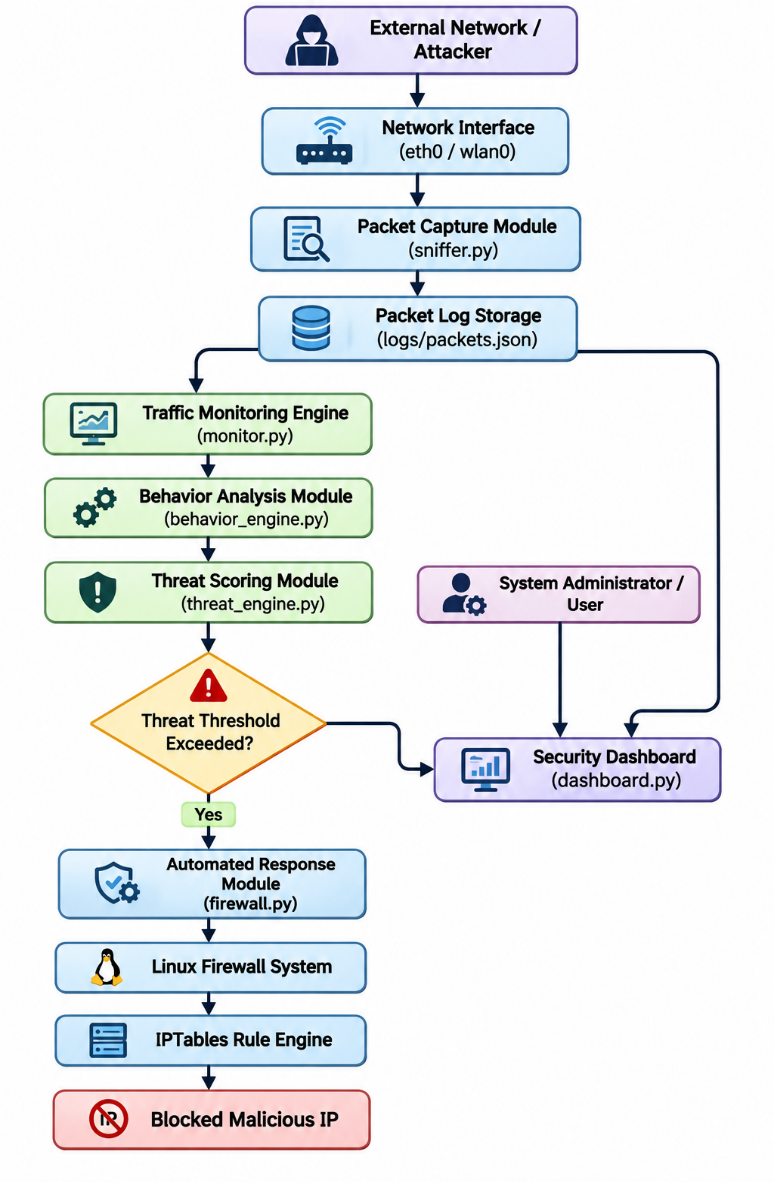
As the internet-based services and online communication grow at an alarming pace, computer networks are becoming more susceptible to cybercrime, including Distributed Denial-of-Service (DDoS) attacks, unauthorized access attempts, and traffic surges. The conventional network security systems are majorly based on the use of fixed firewall settings and manual monitoring systems that tend to lead to a sluggish reaction to the changing threats. Consequently, companies need automated security systems that can identify and respond to malicious actions on a real-time basis. This study introduces the design/implementation of a Real-Time Network Security Monitoring and Auto-Mitigating Firewall System with Python and IPTables. The system is able to constantly scan network traffic, examine packet behavior, and automatically create firewall rules to block suspecting IP addresses without the intervention of the administrator. The developed solution has a low latency, low resources consumption, and stable operation in simulated attack conditions. The system offers an efficient and cost-effective solution to secure network within contemporary computing environment.
Downloads
Published
Issue
Section
License
Copyright of articles published in the International Journal for Interdisciplinary Sciences and Engineering Applications (IJISEA) belongs to the Journal upon acceptance and publication, in accordance with the applicable author copyright agreement.
Authors may reuse their published work for educational and non-commercial purposes, provided that the original publication in IJISEA is properly acknowledged and the applicable permissions are obtained.
Any commercial reproduction, redistribution, republication, or other reuse beyond the permitted rights requires prior written permission from the Editorial Office.
The journal provides open access to its published articles for reading and scholarly reference. Access to published content does not automatically grant unrestricted reproduction or redistribution rights.
All rights not expressly granted remain reserved by the Journal.
 DOI Find a publication by DOI
