
AI-Based Augmented Reality Smart Shopping Assistant
Keywords:
Augmented Reality, Artificial Intelligence, Virtual Try-On, Computer Vision, E-commerce, MediaPipe, Django, Web Application.Abstract
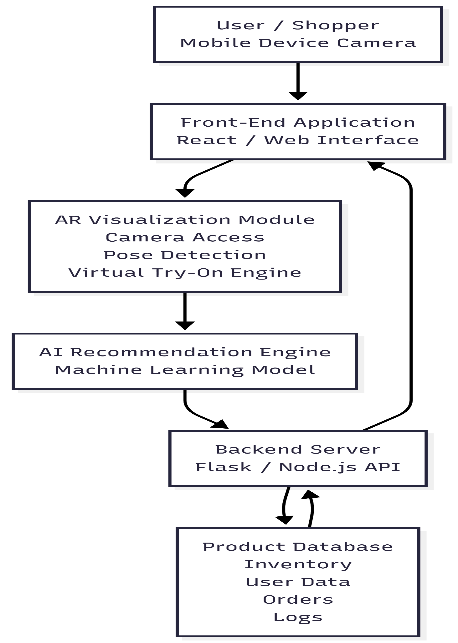
The fast-changing nature of e-commerce sites has greatly changed the retail sector as it allows people to shop easily at a distance. Nevertheless, a common drawback of online clothing shopping is the inefficient possibility to touch and wear clothes prior to the purchase decision. This usually creates confusion, dissatisfaction and high product returns. In order to overcome this problem, this study suggests an Artificial Intelligence (AI)-powered Augmented Reality (AR) Smart Shopping Assistant that offers a real-time virtual try-on experience with computer vision and web-based technologies. The system proposed combines body landmark detection, automatic background removal and dynamic image overlay features to enable users to view clothing items on their bodies by using a web camera interface. The application is created under the Django framework with the MediaPipe-pose detection as the method of locating the shoulder and body landmarks. The architecture is user-authentication-supported, product-management-supported, and real-time visualization, which is why it can be applied to contemporary e-commerce applications. The deployment minimizes the manual preparation of images and enhances the confidence in decision making among the users. The results indicate opportunities of integrating artificial intelligence and augmented reality to enhance digital shopping experiences and aid the creation of intelligent retail platforms.
Downloads
Published
Issue
Section
License
Copyright of articles published in the International Journal for Interdisciplinary Sciences and Engineering Applications (IJISEA) belongs to the Journal upon acceptance and publication, in accordance with the applicable author copyright agreement.
Authors may reuse their published work for educational and non-commercial purposes, provided that the original publication in IJISEA is properly acknowledged and the applicable permissions are obtained.
Any commercial reproduction, redistribution, republication, or other reuse beyond the permitted rights requires prior written permission from the Editorial Office.
The journal provides open access to its published articles for reading and scholarly reference. Access to published content does not automatically grant unrestricted reproduction or redistribution rights.
All rights not expressly granted remain reserved by the Journal.
 DOI Find a publication by DOI
