
Credit Risk Assessment and Decision Support System with Comprehensive Visualization Using Python and Power BI
Keywords:
Credit Scoring, Data Visualization, Machine Learning, Predictive Modelling, Risk ManagementAbstract
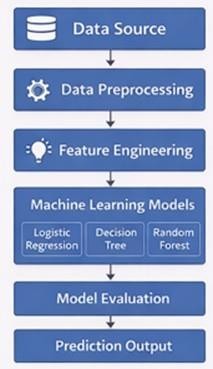
Credit risk assessment is really important in finance because it affects how banks decide on loans and manage risks to stay stable. With all the data piling up and people borrowing in more complicated ways, the old methods just do not cut it anymore for getting quick, accurate info. This project is about building a system that uses machine learning and some visualization tools to fix those issues. It pulls together different parts to predict if someone might default on a loan or not. I used Python for most of it, like Pandas to clean up the data and handle missing stuff, then Scikit-learn to build the models. Matplotlib helped with basic charts along the way. The dataset got processed to pull out features and standardize everything so the models could train properly. I tried out a few classifiers, Logistic Regression, Decision Trees, Random Forest, and Gradient Boosting. They all worked okay, but Random Forest seemed the best, with higher accuracy and it handles those tricky non-linear patterns in the data pretty well. It is robust too, I think. To make it easier for people to use, the results feed into Power BI for dashboards. Those show things like risk charts, how borrower’s group up, trends in defaults, and some key metrics. Stakeholders can poke around without needing to know coding or anything technical. That part stands out because it makes complex predictions more approachable. The system cuts down on manual work and bias from humans, which is a big deal in evaluations. Loans get processed faster; decisions stay consistent. Since it is modular, it can scale up for bigger uses in real finance settings. It seems like there is room to improve, maybe add real-time data or put it on the cloud.
Downloads
Published
Issue
Section
License
Copyright of articles published in the International Journal for Interdisciplinary Sciences and Engineering Applications (IJISEA) belongs to the Journal upon acceptance and publication, in accordance with the applicable author copyright agreement.
Authors may reuse their published work for educational and non-commercial purposes, provided that the original publication in IJISEA is properly acknowledged and the applicable permissions are obtained.
Any commercial reproduction, redistribution, republication, or other reuse beyond the permitted rights requires prior written permission from the Editorial Office.
The journal provides open access to its published articles for reading and scholarly reference. Access to published content does not automatically grant unrestricted reproduction or redistribution rights.
All rights not expressly granted remain reserved by the Journal.
 DOI Find a publication by DOI
