
Real-Time Anomaly Detection in IoT Sensor Data via Deep Learning and Deployment with Python Frameworks
Keywords:
Anomaly Detection, LSTM Autoencoder, IoT Sensor Data, Time-Series Analysis, Deep Learning, Streamlit, Reconstruction Error, Real-Time Monitoring, Predictive Maintenance, MinMax Normalization, Smart Environments, Edge AI.Abstract
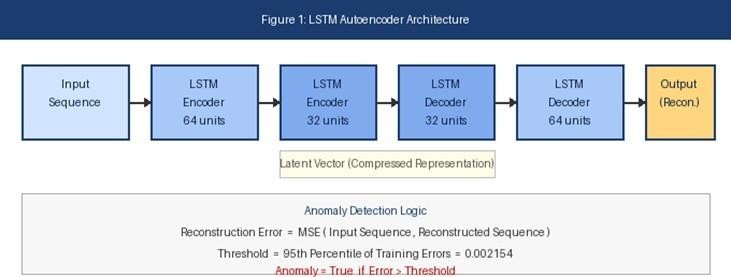
The rapid proliferation of Internet of Things (IoT) devices has generated massive volumes of time-series sensor data that require continuous, intelligent monitoring. This project presents a comprehensive real-time anomaly detection system for IoT sensor data leveraging Long Short-Term Memory (LSTM) Autoencoder neural networks. The system processes multivariate sensor streams — including temperature, humidity, air quality, light intensity, and loudness — and identifies deviations from learned normal patterns using reconstruction error thresholding. The trained model is deployed through an interactive Streamlit-based web application, enabling users to upload CSV datasets, trigger analysis, and explore results through rich interactive visualizations without requiring programming knowledge. Experimental evaluation on a dataset of 6,558 time-series entries yielded an anomaly detection rate of 5.00% at a reconstruction error threshold of 0.002154, demonstrating high detection sensitivity with minimal false positives. The end-to-end pipeline — from raw sensor ingestion and MinMax normalization to sequence generation, LSTM inference, and downloadable labeled outputs — validates the practical viability of deep learning for IoT anomaly monitoring in smart environments.
Downloads
Published
Issue
Section
License
Copyright of articles published in the International Journal for Interdisciplinary Sciences and Engineering Applications (IJISEA) belongs to the Journal upon acceptance and publication, in accordance with the applicable author copyright agreement.
Authors may reuse their published work for educational and non-commercial purposes, provided that the original publication in IJISEA is properly acknowledged and the applicable permissions are obtained.
Any commercial reproduction, redistribution, republication, or other reuse beyond the permitted rights requires prior written permission from the Editorial Office.
The journal provides open access to its published articles for reading and scholarly reference. Access to published content does not automatically grant unrestricted reproduction or redistribution rights.
All rights not expressly granted remain reserved by the Journal.
 DOI Find a publication by DOI
