
A Workforce Harmony Predictor System for Proactive Employee Churn Identification and Strategic Retention Intervention
Keywords:
Machine Learning, HR Analytics, Random Forest, Predictive Modeling, Attrition Prediction, Data MiningAbstract
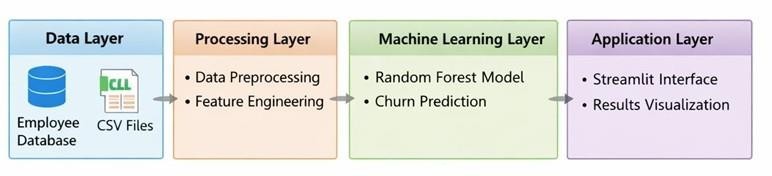
Employee attrition has become a serious concern for many organizations, as it directly affects productivity, costs, and overall stability. Most traditional HR approaches depend on methods like exit interviews and surveys, which only provide insights after employees decide to leave. Because of this, organizations often struggle to take preventive actions. In this paper, we present a Workforce Harmony Predictor System, a machine learning-based solution designed to identify employees who are likely to leave the organization. The system uses important features such as satisfaction level, evaluation score, workload, tenure, and salary to make predictions. A Random Forest model is used, as it provides good accuracy while remaining easy to interpret. The system is implemented as a web application using Streamlit, allowing HR managers to perform both single and batch predictions. The model achieved an accuracy of 87% with a strong ROC-AUC score, indicating reliable performance. Overall, the proposed system helps organizations move from reactive to proactive decision-making and supports better employee retention strategies.
Downloads
Published
Issue
Section
License
Copyright of articles published in the International Journal for Interdisciplinary Sciences and Engineering Applications (IJISEA) belongs to the Journal upon acceptance and publication, in accordance with the applicable author copyright agreement.
Authors may reuse their published work for educational and non-commercial purposes, provided that the original publication in IJISEA is properly acknowledged and the applicable permissions are obtained.
Any commercial reproduction, redistribution, republication, or other reuse beyond the permitted rights requires prior written permission from the Editorial Office.
The journal provides open access to its published articles for reading and scholarly reference. Access to published content does not automatically grant unrestricted reproduction or redistribution rights.
All rights not expressly granted remain reserved by the Journal.
 DOI Find a publication by DOI
