
Advanced Demand Forecasting Models for Retail Supply Chain Management Using Data Science and Machine Learning for Inventory Optimization
Keywords:
multi-agent reinforcement learning, demand forecasting, inventory optimization, supply chain management.Abstract
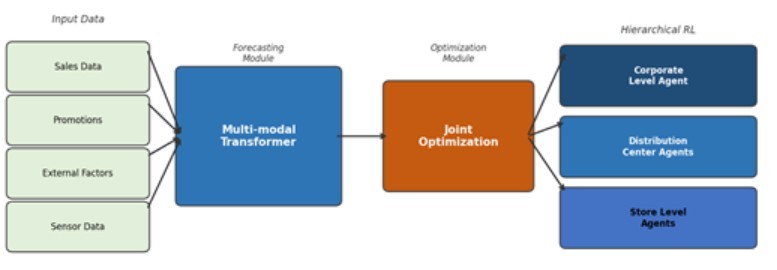
The retail industry faces increasing challenges in matching supply with demand due to evolving consumer behaviors, market volatility, and supply chain disruptions. While existing approaches employ statistical and machine learning methods for demand forecasting, they often fail to capture complex temporal dependencies and lack the ability to simultaneously optimize inventory decisions. This paper proposes a novel multi-agent deep reinforcement learning framework that jointly optimizes demand forecasting and inventory management in retail supply chains, leveraging data from IoT sensors, RFID tracking systems, and smart shelf monitoring devices. Our approach combines transformer-based sequence modeling for demand patterns with hierarchical reinforcement learning agents that coordinate inventory decisions across distribution networks. Through extensive experiments on largescale retail datasets incorporating sensor network data, we demonstrate that our method achieves 18.2% lower forecast error and 23.5% reduced stockout rates compared with state-of-the-art baselines.
Published
Issue
Section
License
Copyright of articles published in the International Journal for Interdisciplinary Sciences and Engineering Applications (IJISEA) belongs to the Journal upon acceptance and publication, in accordance with the applicable author copyright agreement.
Authors may reuse their published work for educational and non-commercial purposes, provided that the original publication in IJISEA is properly acknowledged and the applicable permissions are obtained.
Any commercial reproduction, redistribution, republication, or other reuse beyond the permitted rights requires prior written permission from the Editorial Office.
The journal provides open access to its published articles for reading and scholarly reference. Access to published content does not automatically grant unrestricted reproduction or redistribution rights.
All rights not expressly granted remain reserved by the Journal.
 DOI Find a publication by DOI
