
Control of Squirrel Cage Induction Motor Using Conventional Controllers and Fuzzy Logic
Keywords:
Induction Motor, Speed Control, PID Controller, Fuzzy Logic, Fuzzy-PID Controller, Vector Control, SMATLAB/SimulinkAbstract
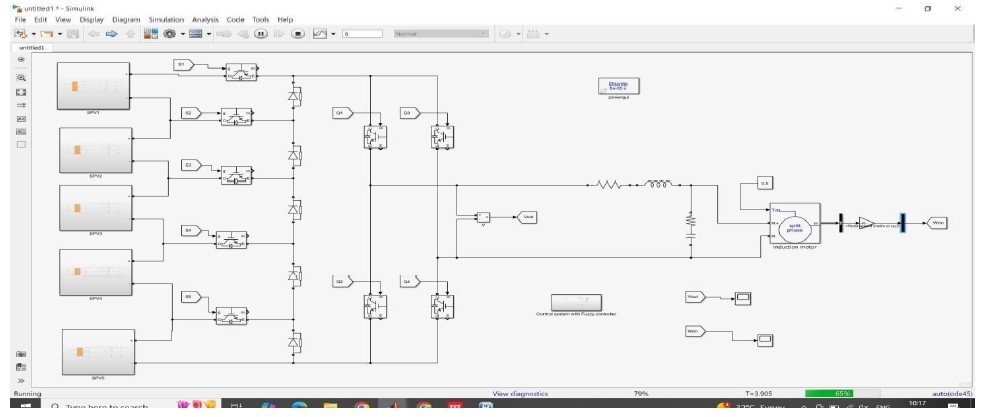
Induction motors, particularly squirrel cage induction motors, are widely used in industrial applications due to their robustness, low cost, simple construction, and minimal maintenance requirements. However, achieving precise and efficient speed control of these motors remains a significant challenge because of their nonlinear characteristics, parameter variations, and sensitivity to external disturbances such as load changes. Conventional control techniques like Proportional-Integral (PI) and Proportional-Integral-Derivative (PID) controllers are commonly employed, but their performance is limited due to fixed gain parameters and poor adaptability under dynamic conditions. This work presents an advanced control strategy for improving the speed control performance of a three-phase squirrel cage induction motor using a hybrid Fuzzy-PID controller integrated with vector (field-oriented) control. The system is modeled mathematically and implemented using MATLAB/Simulink to analyze its dynamic behavior under various operating conditions. The proposed method combines the advantages of conventional PID control with the adaptability of fuzzy logic, enabling real-time tuning of controller parameters. Simulation results are evaluated based on key performance metrics such as rise time, settling time, overshoot, and steady-state error. Comparative analysis with PI, PID, and standalone fuzzy logic controllers demonstrates that the Fuzzy-PID controller provides superior performance with faster response, reduced overshoot, and improved stability. Additionally, it shows strong robustness against parameter variations and load disturbances. Therefore, the proposed approach is highly suitable for modern industrial applications requiring high precision, reliability, and efficiency in motor speed control systems.
Downloads
Published
Issue
Section
License
Copyright of articles published in the International Journal for Interdisciplinary Sciences and Engineering Applications (IJISEA) belongs to the Journal upon acceptance and publication, in accordance with the applicable author copyright agreement.
Authors may reuse their published work for educational and non-commercial purposes, provided that the original publication in IJISEA is properly acknowledged and the applicable permissions are obtained.
Any commercial reproduction, redistribution, republication, or other reuse beyond the permitted rights requires prior written permission from the Editorial Office.
The journal provides open access to its published articles for reading and scholarly reference. Access to published content does not automatically grant unrestricted reproduction or redistribution rights.
All rights not expressly granted remain reserved by the Journal.
 DOI Find a publication by DOI
