10T Monitoring and Automation System in Agriculture Fields
Keywords:
Agriculture, IOT, 'CT, sensors, retrofitting techniquesAbstract
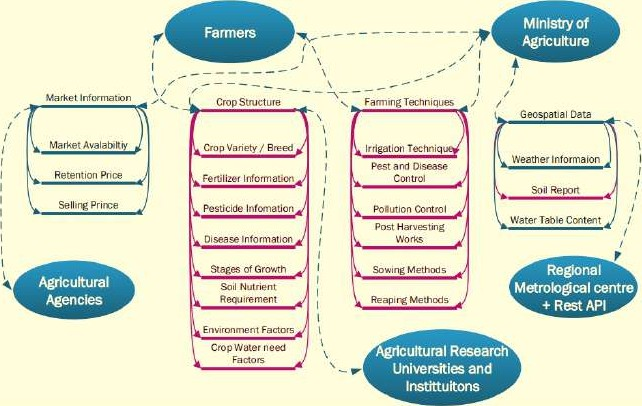
Agriculture sector in the world is diminishing day by day which affects the production capacity of ecosystem. There is an exigent need to solve the problem in the domain to restore vibrancy and put it back on higher growth. The paper proposes an e-Agriculture Application based on the framework consisting of KM-Knowledge base and Monitoring modules. To make profitable decisions, farmers need information throughout the entire farming cycle. The required information is scattered in various places which includes real time information such as market prices and current production level stats along with the available primary crop knowledge. A knowledge dataflow model is constructed connecting various scattered sources to the crop structures. The world around is getting automated replacing manual procedures with the advancement of technology, since it is energy efficient and engross minimal man power. The paper proposes the advantages of having ICT in world agricultural sector, which shows the path for rural farmers to replace some of the conventional techniques. Monitoring modules are demonstrated using various sensors for which the inputs are fed from Knowledge base. A prototype of the mechanism is carried out using Tl CC3200 Launchpad interconnected sensors modules with other necessary electronic devices. A comparative study is made between the developed system and the existing systems. The system overcomes limitations of traditional agricultural procedures by utilizing water resource efficiently and also reducing labour cost.
Downloads
Published
Issue
Section
License
Copyright of articles published in the International Journal for Interdisciplinary Sciences and Engineering Applications (IJISEA) belongs to the Journal upon acceptance and publication, in accordance with the applicable author copyright agreement.
Authors may reuse their published work for educational and non-commercial purposes, provided that the original publication in IJISEA is properly acknowledged and the applicable permissions are obtained.
Any commercial reproduction, redistribution, republication, or other reuse beyond the permitted rights requires prior written permission from the Editorial Office.
The journal provides open access to its published articles for reading and scholarly reference. Access to published content does not automatically grant unrestricted reproduction or redistribution rights.
All rights not expressly granted remain reserved by the Journal.
 DOI