
Design and Implementation of 32-bit ALU with 32 Operations for FPGA-Based RISC Architecture Applications
Keywords:
Arithmetic Logic Unit, Verilog HDL, FPGA, Digital Design,Arithmetic Operations, logic Operations, Clock Gating and PipeliningAbstract
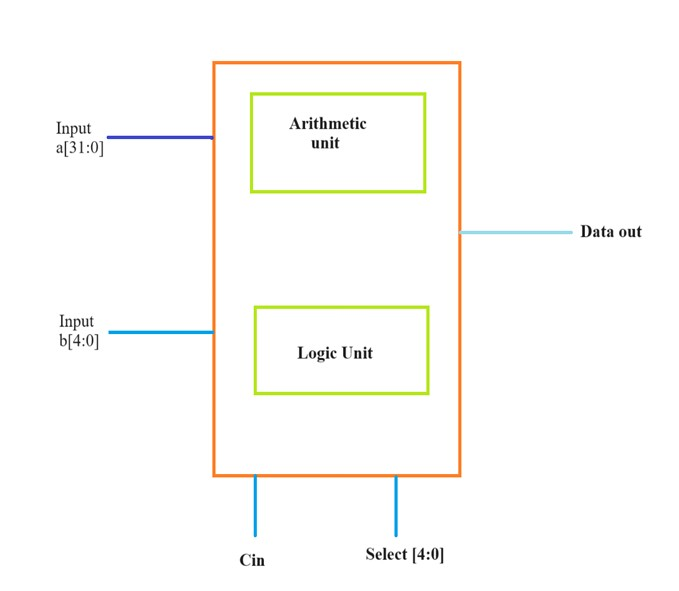
The project focuses on the design and the implantation of a 32-bit Arithmetic Logic Unit (ALU) capable of performing 32 different arithmetic and logic operations based on select lines. The ALU is implemented using Verilog hardware description language (HDL) and synthesized on FPGA hardware.
Each operation is selected using a 5-bit control input, enabling a wide range of arithmetic and logical computations. Primary objective is to showcase the ALU’s functionality and versatility across diverse computing tasks. To optimize power consumption and hardware utilization, the design incorporates
clock gating techniques and pipelining, ensuring efficient operation in resource constrained environments. Pipelining enhances throughput by breakdown operations into sequential stages, maximizing alu utilization. Through extensive simulation and synthesis, the ALU design is rigorously
validated demonstrating both correctness and efficiency in operation. Vivado was utilized for a synthesis and implementation process, ensuring compatibility with FPGA hardware. The ALU is synthesized on Artix 7. FPGA platform, containing 61 cells, 135 i/o port and 1005 nets. Its design to carry out various arithmetic and logic tasks with each operation chosen using a 5-bit control input.
Downloads
Published
Issue
Section
License
Copyright of articles published in the International Journal for Interdisciplinary Sciences and Engineering Applications (IJISEA) belongs to the Journal upon acceptance and publication, in accordance with the applicable author copyright agreement.
Authors may reuse their published work for educational and non-commercial purposes, provided that the original publication in IJISEA is properly acknowledged and the applicable permissions are obtained.
Any commercial reproduction, redistribution, republication, or other reuse beyond the permitted rights requires prior written permission from the Editorial Office.
The journal provides open access to its published articles for reading and scholarly reference. Access to published content does not automatically grant unrestricted reproduction or redistribution rights.
All rights not expressly granted remain reserved by the Journal.
 DOI Find a publication by DOI
