
Low Power Coding Approach Using of Lagger Algorithm in VLSI Design
Keywords:
power optimization, bit transition, lagger algorithm, hamming code, bus shuffling, bit streamsAbstract
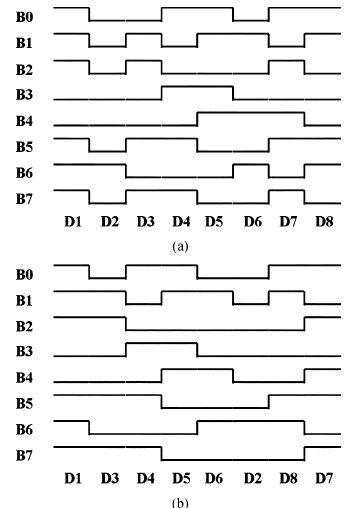
The low power has emerged as a principle design requirement in today’s electronics industry. The need for low power consumption has become important consideration as performance & area. Even several methods exists, still there requires enhancement for optimization of power consumption in VLSI circuits. There were several approaches in circuit level, but a very few approaches made at system level, such as bus transition power consumption. A large amount of power gets dissipated under the transition of bit sequence from ‘0’ to ‘1’ or ‘1’ to ‘0’ transitions. These powers could be saved if these transitions could be minimized. The power optimization approach in bus transitions using Hamming-coding scheme called ‘Lagger algorithm’ for transition power reduction in VLSI design is to be developed. As to minimize the transition, the code bit streams are shuffled before transmission using an Encoder unit and bit streams are regenerated using a decoder algorithm by bus shuffling scheme. The proposed work is to be developed on VHDL definition using active HDL tool for its functional simulation and to be synthesized on Xilinx ISE for synthesis and FPGA editor for its practical realization.
Downloads
Published
Issue
Section
License
Copyright of articles published in the International Journal for Interdisciplinary Sciences and Engineering Applications (IJISEA) belongs to the Journal upon acceptance and publication, in accordance with the applicable author copyright agreement.
Authors may reuse their published work for educational and non-commercial purposes, provided that the original publication in IJISEA is properly acknowledged and the applicable permissions are obtained.
Any commercial reproduction, redistribution, republication, or other reuse beyond the permitted rights requires prior written permission from the Editorial Office.
The journal provides open access to its published articles for reading and scholarly reference. Access to published content does not automatically grant unrestricted reproduction or redistribution rights.
All rights not expressly granted remain reserved by the Journal.
 DOI Find a publication by DOI
