An Experimental Study on Strength Parameters of A Concrete By Using Fly Ash and Demolished Concrete in Cement and Coarse Aggregate With Addition of Fibers
Keywords:
Demolished waste, fly ash, steel fibers, glass fibersAbstract
Next to water Concrete is the world’s most significant and reliable material for the construction.
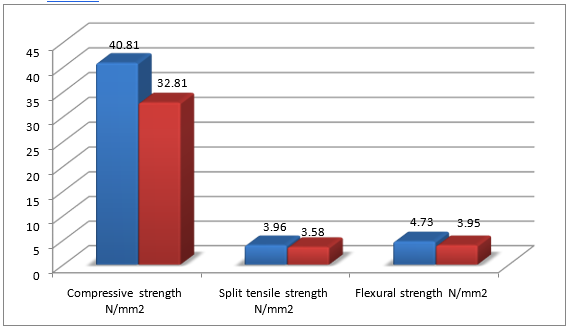
Most of construction is done with concrete. Concrete is a mixture of cement, aggregates and water. Now days we are constructing many new structures in which large amount of cement is used and due to increase in population and luxury in our life we should rebuild our old structures so lot of waste material is also produced. Due to the usage of large amount of cement in global wide, it produces carbon dioxide which is harm full for the atmosphere. Demolished waste material can be used as used as replacement of aggregates. Aim of this project is to reduce the cement content in concrete and use the demolished waste as the replacement of course aggregate. To reduce the cement content cement is partially placement with fly ash in 5%, 10%, 15% and 20% by cement weight to reduce the pollution and to use the waste from the demolished structures coarse aggregate as fully replaced by demolished waste. To increase the durability, flexural strength reduce the plastic shrinkage, dry shrinkage, to enhance life of overall structure and cracks control fibers are used after obtaing of optimal mix in 0% 0.5% 1%, 1.5%, 2%, 2.5% by cement weight. Mechanical Properties of concrete are studied by conducting Compressive, Split Tensile and Flexural tests for 7, 14&28days.
Downloads
Published
Issue
Section
License
Copyright of articles published in the International Journal for Interdisciplinary Sciences and Engineering Applications (IJISEA) belongs to the Journal upon acceptance and publication, in accordance with the applicable author copyright agreement.
Authors may reuse their published work for educational and non-commercial purposes, provided that the original publication in IJISEA is properly acknowledged and the applicable permissions are obtained.
Any commercial reproduction, redistribution, republication, or other reuse beyond the permitted rights requires prior written permission from the Editorial Office.
The journal provides open access to its published articles for reading and scholarly reference. Access to published content does not automatically grant unrestricted reproduction or redistribution rights.
All rights not expressly granted remain reserved by the Journal.
 DOI