
Smart Banking
Keywords:
Fraud detection, online transactions, security.Abstract
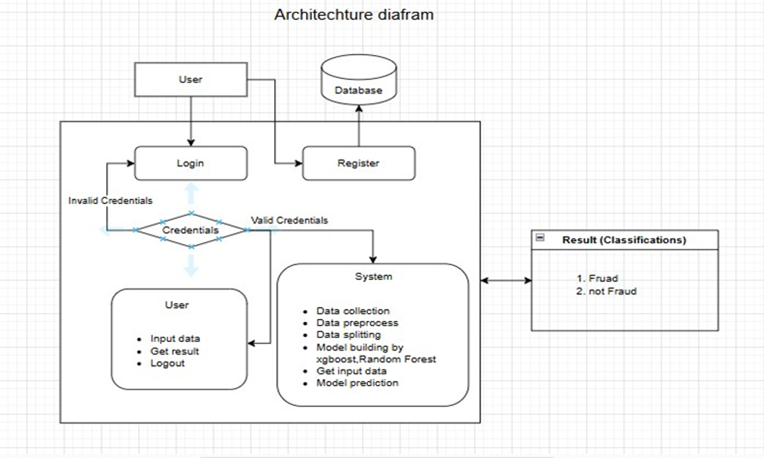
This project aims to detect fraudulent online transactions using machine learning techniques. The dataset includes transaction parameters such as type, amount, and balance details for both sender and recipient. The goal is to predict whether a transaction is fraudulent based on these features. Key parameters include transaction step, type, amounts, balances, and fraud indication. Random Forest and XGBoost algorithms are employed to build predictive models for identifying fraudulent transactions. These models are trained on historical data to classify transactions as legitimate or fraudulent. The Python backend handles data preprocessing, model training, and prediction generation, while the front-end is built using HTML, CSS, and JavaScript, providing a user interface for transaction input and fraud predictions. This system aims to enhance the security of online financial transactions by providing real-time fraud detection and improving the accuracy of fraud identification in payment systems.
Downloads
Published
Issue
Section
License
Copyright of articles published in the International Journal for Interdisciplinary Sciences and Engineering Applications (IJISEA) belongs to the Journal upon acceptance and publication, in accordance with the applicable author copyright agreement.
Authors may reuse their published work for educational and non-commercial purposes, provided that the original publication in IJISEA is properly acknowledged and the applicable permissions are obtained.
Any commercial reproduction, redistribution, republication, or other reuse beyond the permitted rights requires prior written permission from the Editorial Office.
The journal provides open access to its published articles for reading and scholarly reference. Access to published content does not automatically grant unrestricted reproduction or redistribution rights.
All rights not expressly granted remain reserved by the Journal.
 DOI Find a publication by DOI
