
Identification of Plants Through Leaves Image Using Pattern Recognition Techniques
Keywords:
Graph Cuts, Shape Context, Local Binary Patterns, Multi-Layered Perceptron (MLP).Abstract
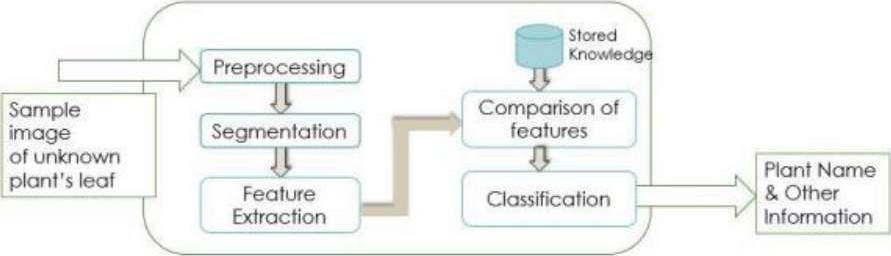
Medicinal plants have l*en used throughout the human history. Ayurveda is one of the oldest medicine systems, which is even recognized in the modern medical society, uses plants for the preparation of medicines. There are thousands Of species Of plants used in the preparation Of medicines. The difficulty lies in the identification of plant species. An hdividual with deep knowledge of plants can only differentiate between these species. This makes leaf identification very difficult. A reference guide to plants identification may ease up the problems, This is where nature needs engineering. In this work, a system is being developed Which helps in the identification Of the plants based on the leaf. This system takes input as a leaf image and outputs the name of the species and other relevant details which are stored in the database. The system is designed using the technique of image identification using pattern recognition. The approach of shape and texture identification, both are combined for designing such a system. The segmentation of the images was done using the techniques of graph-cuts, The descriptor used for shape identification was Shape Context and textures were described using Local Binary patterns. The classification was done using feed forward Multi-Layered Perceptron (MLP) neural network with back propagation training algorithm. The system was tested of certain class of leaves and the performance of the system is compared With an existlng system.
Downloads
Published
Issue
Section
License
Copyright of articles published in the International Journal for Interdisciplinary Sciences and Engineering Applications (IJISEA) belongs to the Journal upon acceptance and publication, in accordance with the applicable author copyright agreement.
Authors may reuse their published work for educational and non-commercial purposes, provided that the original publication in IJISEA is properly acknowledged and the applicable permissions are obtained.
Any commercial reproduction, redistribution, republication, or other reuse beyond the permitted rights requires prior written permission from the Editorial Office.
The journal provides open access to its published articles for reading and scholarly reference. Access to published content does not automatically grant unrestricted reproduction or redistribution rights.
All rights not expressly granted remain reserved by the Journal.
 DOI Find a publication by DOI
